


Why commercial floor maintenance differs between lobbies, retail units and offices
Lobbies and retail floors wear differently to offices, and the cleaning schedule should follow. This guide sets out what each zone needs, why timing matters for slip control and what to put in a specification.
A building does not wear evenly, and its floors are the clearest proof. The entrance takes the grit, the lobby takes the footfall, the corridors take the traffic and the offices at the back take very little. Commercial floor maintenance that treats all of these the same way ends up overspending in some areas and falling short in others, usually in the places that visitors see first.
For facilities managers, property managers and managing agents, the practical question is how to set a cleaning schedule that matches how each part of the building is actually used. Lobbies and retail floors need a different approach to offices, and the difference is about more than frequency. Method, timing and slip control all change as footfall rises. This guide sets out how to think about commercial floor care zone by zone, why the timing of cleaning matters as much as the schedule, and what a workable specification looks like.
Why one cleaning schedule does not suit a whole building
Most cleaning contracts begin with an office specification, because offices are the most common commercial building type. An office floor plate is usually used by the same people each day, is empty for long periods and has predictable soiling. A daily vacuum or damp mop, with a periodic deeper clean, is often enough to keep it presentable.
Lobbies and retail floors work differently. They are used by people who do not know the building, they are open for most of the day, and they receive everything that arrives from outside, including rain, grit and spilt drinks. A schedule written for a quiet office will leave these areas under-served, while the same schedule applied to a low-traffic corridor wastes labour.
The result is a gap between what the contract says and what the building needs. It tends to show up first as complaints from tenants or customers and last in the budget, which is why it is worth designing the schedule around the building rather than copying a template.
How footfall changes the way floors wear
Floors wear from three things, which are abrasion from grit under foot, moisture carried in from outside, and the cleaning process itself. Footfall multiplies all three. A surface that would last for years in a lightly used room can lose its finish in months in an entrance lobby.
Grit is the main driver. Sand, dust and small stones carried in on shoes act as an abrasive under every step, scratching hard floors and working into carpet. Moisture adds a second problem, because wet shoes leave damp patches that are a slip risk and that hold soil against the surface.
This is why the first few metres inside an entrance wear faster than the rest of the floor, and why retail units, where customers move quickly between displays, tend to show wear along their main routes before anywhere else. A schedule that follows these patterns will usually protect the floor better than one that treats every square metre equally.
What each part of the building needs from a floor cleaning schedule
The table below sets out a typical approach by zone. The frequencies are starting points, not fixed rules, and should be adjusted to the building, the floor type and the season.
Zone | Main wear and soiling | Typical regime | Best timing |
Entrance and first few metres inside | Grit, rain, mud, leaves | Several checks a day, with wet mats swapped and floors dried quickly | During opening hours, in short and quiet passes |
Lobby and reception | Footfall, scuffing, spills | Daily clean, spot checks during the day | Before opening, with light attention in between |
Retail sales floor | Heavy footfall along set routes, trolleys, spills | Daily clean, with spot cleaning during trading | Machine scrubbing after closing |
Corridors and circulation routes | Steady traffic, trolley marks | Daily to several times a week | Before or after the busiest periods |
Office floor plates | Light, even soiling | Daily vacuum or damp clean | Outside working hours |
Stairwells and landings | Grit, handrail contact | Several times a week | Quiet periods |
Entrances and lobbies
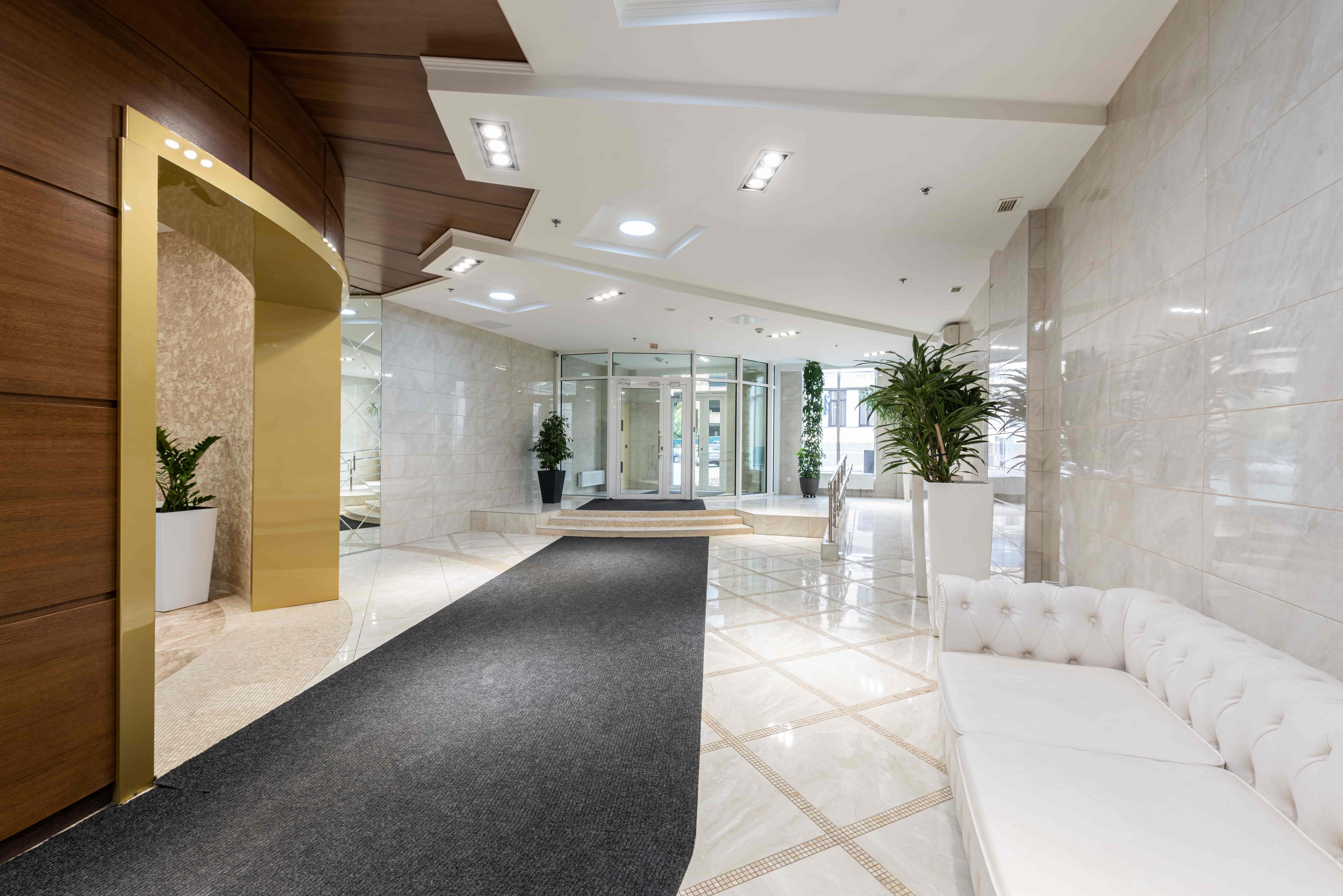
The entrance zone does the most work and is judged the fastest. A lobby that looks tired or damp sets the tone for the whole building, and it can present a significant slip risk during wet weather. Attention here is best given in short, frequent passes rather than one thorough clean, because the floor is only clean until the next group of people walks in.
Retail sales floors
Retail floor cleaning has to cope with heavy footfall along fixed routes, and with the added risk of spills from customers. Daily cleaning is the baseline, with spot cleaning during trading and heavier work, such as machine scrubbing, after the doors close. The wider scope of a retail contract, including toilets, fitting rooms and shared areas, is covered in our guide to what retail cleaning needs to cover in a shop or shopping parade, so this guide stays with the floor itself.
Corridors and office floor plates
Corridors fall between the two. They carry steady traffic but little moisture once people are inside, so they usually need a regular clean without the extra attention of the entrance. Office floor plates are the lightest, and a daily routine with a periodic deeper clean is usually enough. For a wider view of frequency across a whole building, see our guide on how often a commercial building should be cleaned.
Why the timing of floor cleaning matters as much as the frequency
A floor that has just been cleaned is not always a safe floor. The Health and Safety Executive states that slips and trips are the single most common cause of major injury in retail, and its guidance points to floors left wet after cleaning as a frequent cause. Even a well-wrung mop leaves a thin film of water that can create a slip risk on a smooth floor.
For this reason, the HSE advises keeping people off smooth wet floors by using barriers, locking doors or cleaning in sections, and notes that signs and cones only warn of a hazard rather than preventing access. Its guidance on slips and trips in retail also says that spills should be cleaned up immediately and the floor left dry.
In practice, this means that the busiest zones need a different method as well as a different frequency. Heavy wet cleaning belongs outside opening hours. During trading, dry or low-moisture methods, spot cleaning and quick response to spillages protect both the floor and the people walking on it. An HSE case study of a supermarket entrance describes staff switching from mopping to a wet vacuum that left the floor dry, alongside extra matting in wet weather, which is a good illustration of method changing with the zone.
Employers are also expected to assess the risk from slips and trips and take reasonable precautions, so a floor cleaning schedule is part of risk management and not only a matter of appearance.
How entrance matting reduces the cleaning workload
Most of the soil on a lobby floor arrives on shoes. Entrance matting that is well specified and kept in good condition captures a large share of it at the door, which reduces both the abrasion on the floor beneath and the amount of cleaning needed inside.
Matting only works if it is maintained. A mat that is saturated or full of grit becomes less effective at capturing dirt and moisture and can become a slip or trip hazard itself, so mats need regular vacuuming, rotation or replacement, particularly in wet weather. In many buildings, the cheapest improvement to a floor care programme is a better matting arrangement at the entrance, followed by a schedule that includes the mats themselves.
Our guide to how often commercial floors should be polished explains how matting also extends the life of a polished finish, which is one reason the two should be planned together.
How routine cleaning and periodic polishing work together
Routine cleaning keeps a floor clean, but it does not restore a finish that has worn away. Over time, heavy footfall, abrasive dirt and unsuitable cleaning methods can degrade a floor's finish. Depending on the surface type and condition, periodic polishing or specialist restoration may be needed.
The two should be planned as one programme. Daily and weekly cleaning is set by zone, as described above, and periodic treatments are scheduled on top, with the busiest zones usually needing them most often. Keeping them separate tends to leave the periodic work to be commissioned reactively, after the floor has already deteriorated. The frequencies for each floor type are set out in the polishing guide linked above, so they are not repeated here.
What to include in a commercial floor cleaning specification
A written specification removes most of the disagreements that arise between a contractor and a property manager. For commercial floor cleaning, it works best when it covers the following points.
A zone map of the building, showing entrances, lobbies, corridors, sales floors and office areas
The cleaning frequency for each zone, with a different regime for the busiest areas
The method and equipment for each floor type, and the products to be used
The timing of heavy cleaning, and how wet floors are kept clear of people while they dry
How spills and weather-related problems are reported and dealt with during opening hours
How entrance matting is maintained, including who swaps wet or worn mats
Which periodic treatments, such as polishing, sit inside the contract and which are priced separately
How standards are inspected and reported
The same approach applies to shared lobbies in managed and multi-let buildings, where the specification also needs to say who is responsible for what. Our guide to communal area cleaning in a managed building covers that side in more detail.
Common mistakes in commercial floor care
Several patterns appear repeatedly in buildings where floors are wearing faster than expected. The first is applying an office specification to the whole building, which leaves entrances and sales floors under-served. The second is cleaning at the wrong time, so that wet floors meet the busiest part of the day.
A third is ignoring the entrance, where a small improvement in matting does more than extra cleaning inside. Another is treating polishing as an occasional extra, instead of planning it alongside routine cleaning. Finally, many schedules are set once and never reviewed, even when opening hours, footfall or the season change. A short review each autumn, before wet weather arrives, is usually enough to catch the problems before they show.
Support for planned floor cleaning in lobbies and retail units
Classic London provides floor polishing and commercial office cleaning for buildings across London and the South East, working with property managers and managing agents on schedules that fit how a building is used.
If you are reviewing a floor care programme, or want to talk through how the schedule for a particular lobby or retail floor should differ from the rest of the building, speak with the Classic London team before the next wet season rather than after it.
Common Questions
Everything you need to know about our services and processes