



The Importance of Commercial Cladding Cleaning for Managed Buildings
Cladding covers a significant proportion of most modern commercial buildings, yet it is one of the most frequently overlooked elements in a building maintenance programme. This guide explains why commercial cladding cleaning matters, what the service involves, and how it fits alongside window cleaning and other exterior maintenance for managed commercial properties.
Cladding covers a significant proportion of the exterior surface area of most modern commercial buildings. It is one of the most visible elements of a building's facade, and its condition has a direct bearing on how the building presents itself to tenants, visitors and the street. Yet cladding is one of the most frequently overlooked elements in a commercial building maintenance programme.
Window cleaning schedules are common. Cladding cleaning is often left out entirely, or addressed only when the deterioration becomes visible enough to prompt a complaint.
For property managers and facilities teams responsible for the long-term condition and presentation of commercial buildings, understanding why cladding cleaning matters and what it involves is a practical starting point for better exterior maintenance planning.
What Commercial Cladding Is and Why It Gets Dirty
Modern commercial buildings use a wide range of cladding materials, including aluminium composite panels, glass reinforced concrete, steel, stone, terracotta, ceramic tile and various composite systems. Each material has different surface characteristics, different maintenance requirements and different rates of soiling, but all of them accumulate dirt, pollution residue and biological growth over time when exposed to the urban environment.
In London, the combination of vehicle exhaust particulates, airborne pollution, carbon deposits, bird fouling, algae and general atmospheric soiling means that exterior cladding on commercial buildings deteriorates visually at a faster rate than in less polluted environments.
The soiling is not always uniform. Traffic-facing elevations accumulate more pollution residue, while areas with limited airflow or greater moisture exposure encourage biological growth. Recessed panels and horizontal surfaces also collect debris that vertical surfaces shed more easily.
The result, on a building that has not had its cladding cleaned for several years, is an exterior that looks significantly older and less well maintained than the building actually is. The glass may be kept clean through a regular commercial window cleaning programme, but clean windows against stained or discoloured cladding panels produce a result that is immediately visible and undermines the overall presentation of the building.
Why Cladding Cleaning Is Often Left Out of Maintenance Programmes
Several factors contribute to cladding cleaning being overlooked in commercial building maintenance planning.
It is less immediately visible than window condition
Dirty windows are noticed quickly because they affect transparency and the quality of light inside the building. Cladding soiling accumulates gradually and is often not noticed until it is pointed out or a building is compared directly with a recently cleaned neighbouring property.
Access adds complexity and cost
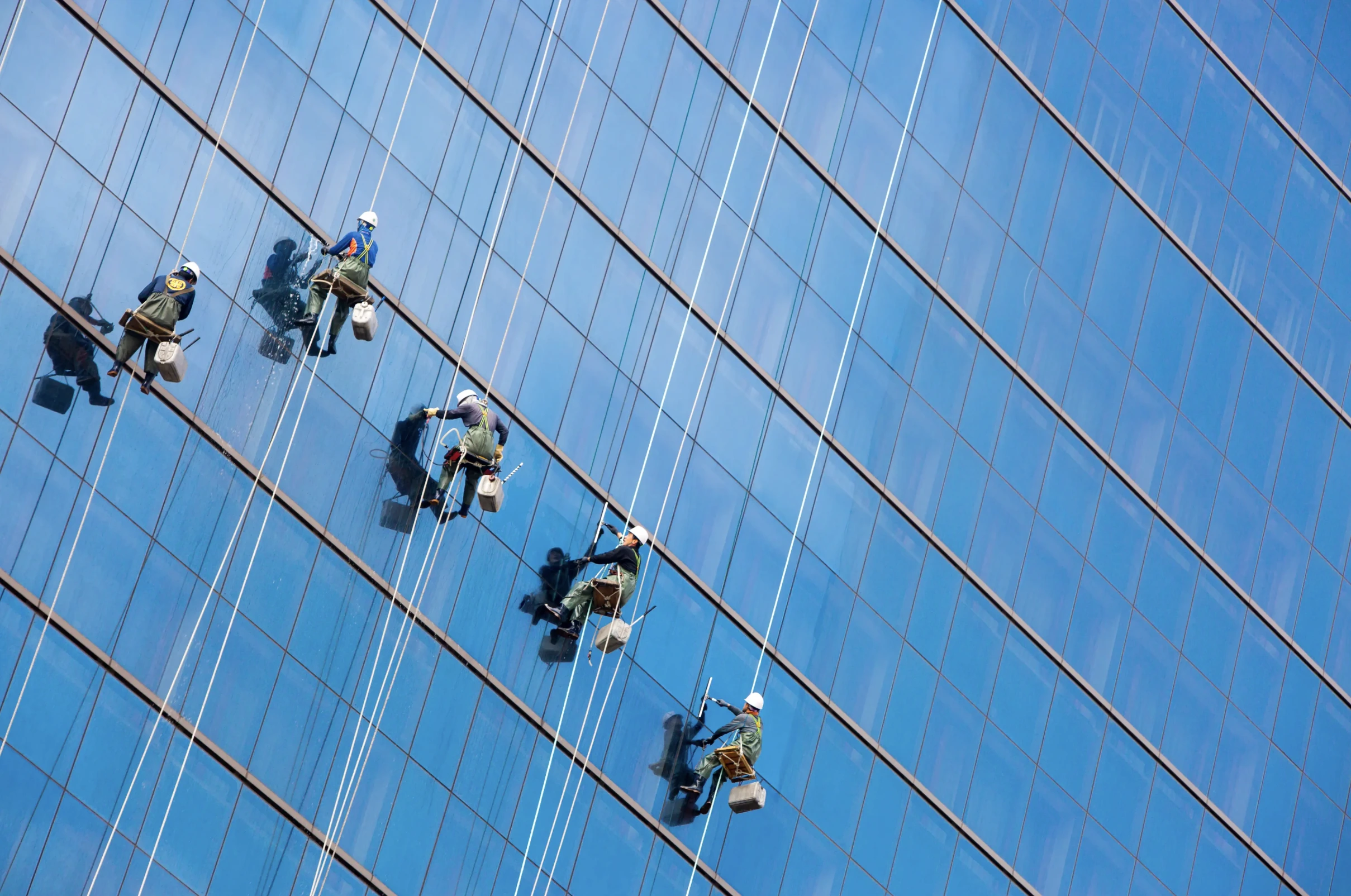
Cladding on multi-storey commercial buildings cannot be cleaned from the ground. It requires the same access methods as high-level window cleaning, including MEWPs, abseiling or cradle systems, which adds to the cost and the planning required. This sometimes leads to cladding cleaning being deferred in favour of tasks that are more straightforward to schedule.
It falls between service categories
Cladding cleaning sits between window cleaning and general building maintenance in terms of how it is categorised, which means it can fall through the gaps in a building's maintenance plan if neither the window cleaning contractor nor the general maintenance contractor has explicitly taken responsibility for it.
Understanding these factors helps property managers address the gap deliberately rather than leaving it to chance.
What Commercial Cladding Cleaning Involves
The cleaning method used for commercial cladding depends on the material, the nature and extent of the soiling, and the height and access constraints of the building. The main approaches used for commercial cladding cleaning are:
Pressure washing and soft washing: For robust cladding materials such as concrete, brick and some metal panels, controlled pressure washing removes general soiling, algae and biological growth effectively. Soft washing, which uses lower pressure combined with appropriate cleaning agents, is used for more sensitive materials where high pressure could cause damage or water ingress.
Specialist chemical cleaning: Some soiling types, including heavy carbon deposits, industrial staining and deeply embedded pollution residue, require specialist chemical treatments applied by experienced operatives. The cleaning agent must be matched to the cladding material to avoid surface damage or discolouration.
Manual cleaning at height: For detailed cleaning of panel joints, recessed sections and areas where pressure equipment cannot be used effectively, manual cleaning by operatives working from an access platform or rope access system is the appropriate method.
DOFF and TORC systems: For heritage or sensitive cladding materials, specialist low-pressure steam or gentle abrasive cleaning systems are used to remove soiling without damaging the substrate. These are less common in standard commercial cladding cleaning but relevant for buildings with stone, terracotta or other sensitive facade materials.
Access for high-level cladding work follows the same principles as high-level window cleaning. Classic London's abseiling and high-level access team provides the access capability for cladding cleaning on buildings where ground-based equipment cannot reach the full facade.
Cladding Cleaning and Window Cleaning: Planning Them Together
The most practical and cost-effective approach to exterior facade maintenance for commercial buildings is to plan cladding cleaning and window cleaning together rather than as separate programmes. The access requirements for both are broadly the same, the scheduling considerations overlap, and combining them reduces the total number of access mobilisations needed over the course of a year.
A building whose windows are cleaned every six to eight weeks but whose cladding is never cleaned will gradually develop a visual imbalance that becomes increasingly difficult to ignore. Conversely, a building whose cladding is cleaned annually as part of a coordinated exterior maintenance programme alongside regular commercial window cleaning in London maintains a consistently professional exterior presentation year-round.
When reviewing a building's exterior maintenance programme, it is worth asking whether cladding cleaning is explicitly included in any current contract, how frequently it is being carried out, and whether the contractor responsible for window cleaning has the capability to include cladding within the same programme. Our guide to choosing a commercial window cleaning contractor covers what to look for when assessing a contractor's capability for this type of work.
The Consequences of Neglecting Cladding Cleaning
Leaving cladding uncleaned for extended periods has consequences beyond appearance alone.
Biological growth accelerates surface degradation
Algae, lichen and moss retain moisture against the cladding surface. Over time, this accelerates surface degradation on susceptible materials, particularly around panel joints, fixings and sealant lines where moisture ingress is already a risk.
Soiling becomes harder to remove
Light surface soiling that could be removed with a straightforward clean becomes increasingly embedded over time. Heavily soiled cladding that has been left for several years typically requires more intensive treatment, longer access time and higher cost to restore than the same cladding maintained on a regular cleaning cycle.
It affects tenant and occupier confidence
The exterior condition of a building is a visible signal of management quality. Tenants whose clients and visitors arrive at a building with visibly stained or discoloured cladding notice it, and it affects how they perceive the management of the property they occupy. How Often Should Commercial Cladding Be Cleaned?
Frequency depends on the building's location, the cladding material and the standard the property needs to maintain. As a general guide:
Building Type | Recommended Frequency |
High-footfall city centre commercial | Every 12 months |
Managed office campus or business park | Every 12 to 24 months |
Buildings near high-traffic roads | Every 12 months |
Buildings in lower-pollution locations | Every 18 to 24 months |
Heritage or sensitive facade materials | As advised by specialist |
These are starting points rather than fixed rules. A building that has not been cleaned for several years may require an initial intensive clean before a regular maintenance frequency can be established.
Frequently Asked Questions
What is the difference between cladding cleaning and facade cleaning? The terms are often used interchangeably. Facade cleaning refers broadly to the cleaning of a building's exterior face, which may include windows, cladding panels, stonework and other surface materials. Cladding cleaning refers specifically to the non-glazed panel elements of the exterior. In practice, a coordinated exterior maintenance programme covers both as part of the same scope.
Can cladding cleaning damage the panels? When carried out correctly with the appropriate method for the material, commercial cladding cleaning does not damage panels. Using the wrong cleaning method or pressure setting for a particular material can cause surface damage, which is why matching the cleaning approach to the cladding specification matters. Reputable contractors will assess the material before specifying the cleaning method.
Does cladding cleaning require the same access as window cleaning? Yes, for multi-storey buildings. Cladding on upper floors requires access via MEWPs, abseiling or cradle systems, the same methods used for high-rise window cleaning. This is one of the practical reasons for combining cladding and window cleaning programmes, as the access mobilisation cost is shared across both tasks.
How long does commercial cladding cleaning take? Duration depends on the building size, the extent of soiling, the access method required and the cleaning technique used. A straightforward clean of a mid-rise commercial building may take one to two days. Larger buildings or those requiring specialist chemical treatment or sensitive cleaning methods will take longer. A site assessment before works begin gives a more accurate programme estimate.
Is cladding cleaning included in standard window cleaning contracts? Not always. Many window cleaning contracts cover glazed surfaces only and do not explicitly include cladding panels. It is worth confirming the scope of any existing contract and, where cladding is not included, discussing whether it can be incorporated into the programme or scheduled as a separate annual clean.
Making Cladding Part of the Maintenance Programme
Commercial cladding cleaning is not a specialist task that sits outside normal building maintenance planning. It is a straightforward element of exterior building care that produces a meaningful improvement in how a building presents itself and protects the long-term condition of the facade. The practical barrier is usually that it has not been explicitly included in the maintenance programme rather than that it is difficult or disproportionately expensive to carry out.
For property managers and facilities teams looking to address cladding as part of a coordinated exterior maintenance approach, Classic London provides commercial window cleaning services that extend to cladding cleaning for commercial buildings across London and the South East. To discuss the exterior maintenance requirements for your building, speak with the Classic London team.