



How to Choose a Commercial Window Cleaning Company
Choosing a commercial window cleaning contractor involves more than comparing prices. This guide covers what property managers and facilities teams should look for, from access methods and insurance to frequency, qualifications and what consistent service actually looks like in practice.
How to Choose a Commercial Window Cleaning Company
For most commercial buildings, window cleaning is one of those services that only gets noticed when it goes wrong. Streaked glass, missed sections, a contractor who does not show up on schedule, or a company that cannot safely access upper floors without proper equipment: these are the points at which facilities managers and property teams realise that not all window cleaning contractors are the same.
Choosing the right company is a more considered decision than it might appear. The building's size, height, access constraints, the frequency of cleaning required and the standards the property needs to maintain all affect which contractor is genuinely suitable. This guide covers the key factors worth assessing before committing to a contract, so the decision is based on more than price alone.
Understand What Your Building Actually Needs First
Before approaching any contractor, it is worth being clear about what the building requires. A low-rise office with accessible frontage has very different needs from a multi-storey commercial building with complex facade geometry and limited ground-level access.
Key questions to work through before requesting quotes:
How many floors and what is the approximate glazed area?
What access methods are currently available or feasible around the building?
How frequently does the building need cleaning to maintain the standard expected?
Are there any restricted areas, occupied zones during working hours, or access constraints that affect how the work can be carried out?
Does the building have anchor points, davit systems or other permanent access infrastructure already in place?
Having clear answers to these questions makes it easier to compare contractors on a like-for-like basis, and it quickly reveals whether a company has genuinely assessed the building or is simply quoting from a description.
Check That the Contractor Can Handle the Access Requirements
The access method is one of the most important practical considerations in commercial window cleaning, and it varies significantly depending on building height, design and location. A contractor who only operates water-fed pole systems is not the right choice for a building that requires abseiling or cradle access at upper levels. Equally, a contractor who defaults to heavy access equipment for a building that could be cleaned more efficiently from the ground is likely to be over-specifying and overcharging.
The main access methods used in commercial window cleaning are:
Water-fed pole systems: Suitable for buildings typically up to around five or six storeys. Purified water is fed through an extendable pole and brush head, leaving glass clean without the need for a squeegee or detergent. Safe, efficient and minimally disruptive for lower-level work.
Cherry pickers and MEWPs: Mobile elevating work platforms provide a safe elevated working position for mid-height buildings where ground access is available. Suitable where the surrounding ground is firm and there is sufficient space to deploy the machine.
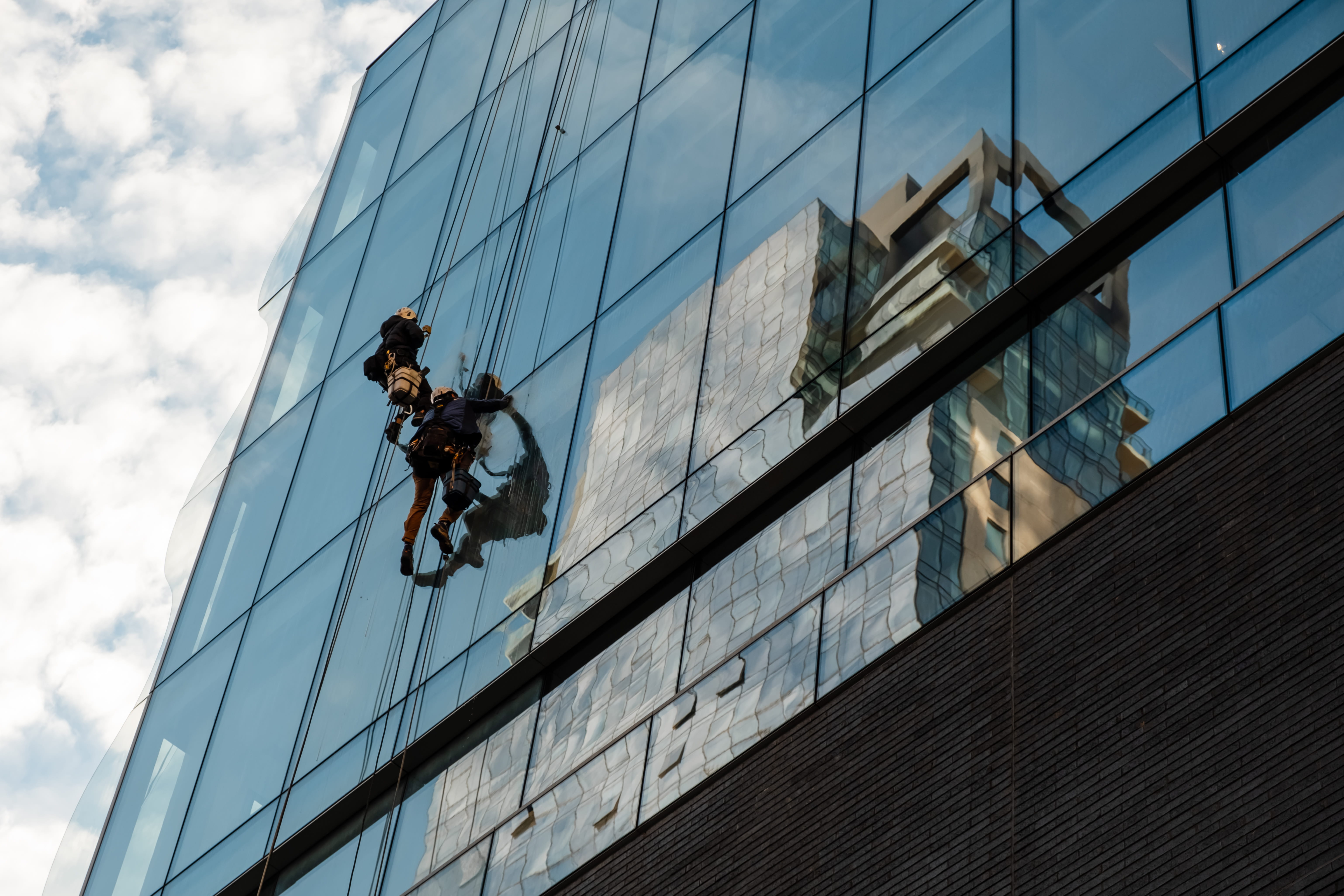
Abseiling and rope access: Used for high-rise buildings, complex facades, or structures where no stable ground position exists for platform equipment. Operatives work from anchor points at roof level, providing access to the full height of the building without ground-based equipment. Classic London's abseiling and high-level access team handles this type of work across London's commercial buildings.
Cradle and suspended access systems: Used on buildings with permanent cradle infrastructure. The system travels along the roofline and lowers operatives to work across the facade.
A contractor worth considering should be able to explain clearly which access method is appropriate for the building and why, and should have demonstrable experience with that method rather than simply listing it as a capability.
For more on how window condition affects first impressions and why it matters to building management, that is covered separately.
Verify Insurance and Accreditations
Commercial window cleaning, particularly at height, carries real risk. The contractor working on the building should hold appropriate public liability insurance, and for high-level work, employers' liability insurance for all operatives on site. Asking for evidence of current insurance certificates before agreeing a contract is straightforward and entirely reasonable.
Beyond insurance, relevant accreditations indicate that a contractor operates to recognised industry standards. These include:
IPAF (International Powered Access Federation): Relevant for operatives using MEWPs and cherry pickers. IPAF-trained operatives have demonstrated competency to use specific categories of access equipment.
IRATA (Industrial Rope Access Trade Association): The recognised standard for rope access work. IRATA-certified operatives are graded at different levels depending on their experience and the complexity of work they are qualified to carry out.
Safe Contractor or CHAS accreditation: These health and safety pre-qualification schemes indicate that a contractor has been assessed against recognised standards. Many facilities managers and property teams require one or both as a minimum before engaging a new contractor.
A company that cannot provide evidence of relevant insurance and accreditation for the type of work required is not suitable for commercial contracts, regardless of price.
Ask About Frequency and Scheduling
Window cleaning frequency for commercial buildings depends on location, building use, footfall and the standard the property needs to maintain. A busy retail unit on a high-footfall street will need cleaning more often than a managed office building set back from the road. Buildings near construction activity or in areas with high pollution may also require more frequent attention.
As a general guide, most commercial buildings in London benefit from external window cleaning every four to eight weeks, with some high-profile or client-facing buildings cleaned more frequently. Internal glass in reception areas, meeting rooms and communal spaces may be included in the cleaning schedule or managed separately as part of an office cleaning programme.
When discussing frequency with a contractor, ask how scheduling is managed, how the company handles missed visits due to weather or access issues, and what the process is for raising concerns or requesting additional cleans when needed. A contractor with a clear, organised approach to scheduling and communication is significantly easier to work with over the life of a contract than one who operates reactively.
Look for Evidence of Consistency Over Time
Consistency matters more than an impressive first clean. A contractor who delivers a good result at the start of a contract but becomes unreliable after a few months creates more problems for a facilities team than one who maintains a steady, predictable standard throughout.
When assessing a contractor, ask for references from current clients with similar building types or access requirements. Ask how long those relationships have been in place. A window cleaning company with long-standing contracts across a portfolio of commercial buildings in London is demonstrating something that a low quote alone cannot: that the service holds up over time.
Classic London's commercial window cleaning services are built around consistency and scheduled delivery rather than one-off visits, which is what building management teams actually need from a long-term contractor.
Understand What Is and Is Not Included
Before signing a contract, be clear on exactly what the service covers. Some contractors include both internal and external cleaning as standard; others price them separately. Frame cleaning, sill cleaning, and the cleaning of communal glass in lobbies and stairwells may or may not be included depending on how the contract is scoped.
It is also worth clarifying how the contractor handles reactive requests, such as cleaning after building work, weather events, or specific incidents that leave glass in a poor condition outside of the regular schedule. Knowing whether this is included, charged as an addition, or not offered at all avoids disputes later.
Frequently Asked Questions
How often should a commercial building's windows be cleaned?
→ Most commercial buildings benefit from external cleaning every four to eight weeks. High-footfall retail premises, client-facing buildings and properties in areas with higher pollution or construction activity often require more frequent visits. The right frequency depends on the building's location, use and the standard expected.
What qualifications should a commercial window cleaning company have?
→ For ground-level and low-rise work, public liability insurance and a professional track record are the minimum. For high-rise and rope access work, IRATA certification is the recognised standard. For MEWP-based access, IPAF certification applies. Safe Contractor or CHAS accreditation is commonly required by facilities managers and property teams as a baseline for new contractors.
What is the difference between reach and wash and abseiling for window cleaning? → Reach and wash uses purified water fed through an extendable pole and is suitable for buildings up to around five or six storeys. Abseiling uses rope access techniques from roof-level anchor points and is used for taller buildings or facades where ground-based access is not practical. The right method depends on the building's height, design and the access available around it.
How do I get an accurate quote for commercial window cleaning?
→ The most reliable quotes come from contractors who have visited the site and assessed the building directly. A quote based only on a description or a photograph is unlikely to be accurate, particularly for buildings with complex facades, restricted access, or high-level glazing that requires specialist equipment.
Can commercial window cleaning be carried out while the building is occupied?
→ Yes, in most cases. Water-fed pole systems and rope access work can generally be carried out without significant disruption to building occupants. For MEWP-based access in areas with pedestrian traffic, the contractor should manage ground-level exclusion zones appropriately. Any specific requirements around occupied zones or working hours should be discussed and agreed before the contract begins.
Making the Right Decision for the Building
Choosing a commercial window cleaning company in London is ultimately a question of fit: the right access capability for the building, appropriate qualifications for the work involved, a track record of reliability, and a clear understanding of what the contract covers. Price matters, but a contractor who cannot access the full building safely, who lacks the relevant accreditations, or who becomes inconsistent after the first few months will cost more in the long run than a slightly higher quote from a company that delivers properly.
For property managers and facilities teams looking for dependable, properly qualified commercial window cleaning in London, Classic London covers buildings across the capital and the South East, including high-rise and complex access work. To discuss your building's requirements, speak with the Classic London team.